
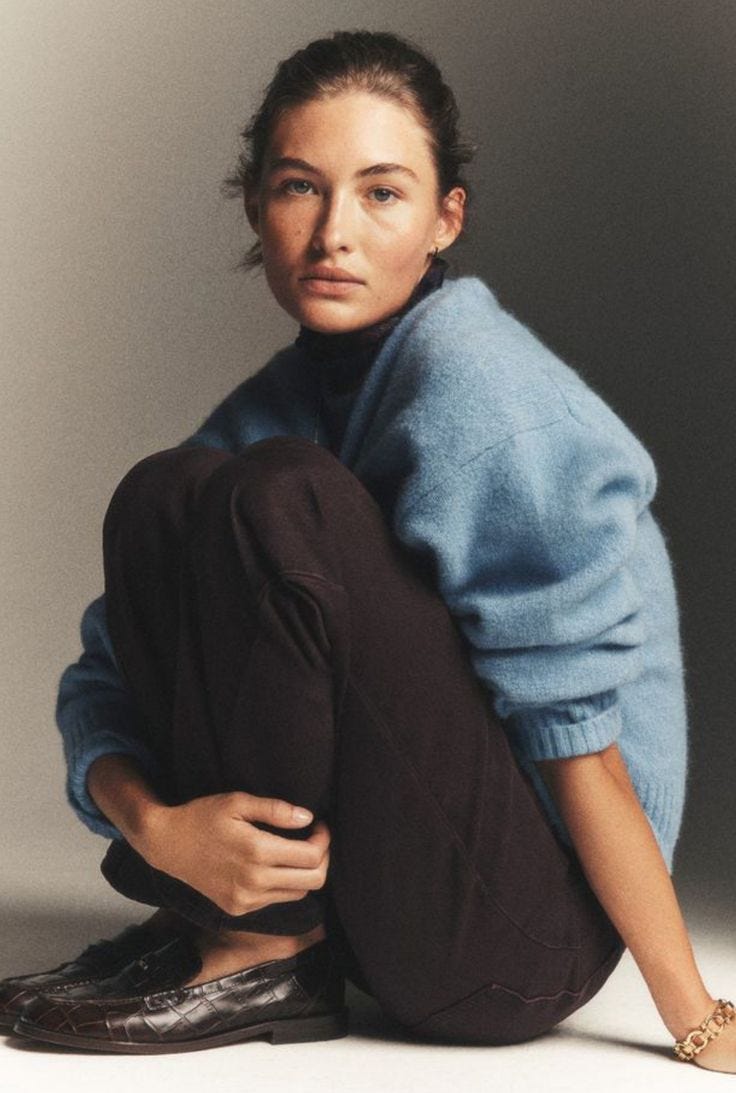
137. The Silhouette That Won't Behave
Finding Freedom in the Slouch.
This morning felt heavy, and I struggled to make sense of writing this newsletter while the news came in on my phone. I want to leave no ambiguity around my feelings about the disgusting actions of the US government, its encouragement of ICE to act with impunity—murdering and detaining people. I care deeply about immigrant justice. Sending love and warm hugs to my readers around the world, especially my US readers, particularly those in Minnesota. Thank you for leading the way against fascism.
I’ve come a long way in letting go of styling rules. Years ago, I founded a petite clothing brand, dressing and styling short women with designs graded to their proportions. I was living and breathing the brand’s purpose; there was so much demand for solutions to the everyday struggle of feeling good in standard-sized fashion (not just for short women). I thought I could find answers for everyone through Cartesian-style rules. I became obsessed with the concept of ‘clothes that fit right’, developed tunnel vision, and I fear I led a few people down that tunnel with me. Years later, the brand I founded is no more, and sizing and fit remain the number-one complaint people have about shopping. However, I have changed my perspective on how I can help women feel more confident when getting dressed.
Because not much about getting dressed is Cartesian—and what does ‘fitting right’ mean anyway? Clothes that follow the contour and curves of the body, I assumed. But the contour and curves of my body are soft, supple, and ever-changing.
When I let my intuition dress me, I reach for clothes that fit loosely around my body, and I take deep exhales. When I reach for clothes that are fitted to my body, like my twenty-year-old motorbike jacket that looks dated and is oh-so-fun, it feels playful and experimental. I no longer think about whether they make me look taller or leaner.
Fitted doesn’t, but fit still matters a whole lot. My favorite pieces to reach for include exaggeratedly baggy, dropped-crotch pants (always from here). The design brains behind them have all but ignored the body’s contour. They studied it with precision to create a silhouette that far surpasses flattering. It succeeds in communicating both ease and intent. That kind of silhouette—roomy, draped, a little off-duty on purpose—has a name: slouch.
Ways to build slouch into an outfit, illustrated in this newsletter, include:
pushed up sweater and jacket sleeves (1 + 14)
the slouchy shaft of a knee or thigh-high boot (17)
crisp cotton poplin (beyond shirting) (3 + 15 + 16)
a scarf or shawl worn ‘tails-back’ over your shoulders (8 + 9)
a button-down with sleeves pushed up or folded (3 + 5 + 7)
a pair of jeans or pants with a dropped crotch (4 + 7 + 11)
a slim-enough pant leg to pool over a pair of shoes without dragging (4)
a fabric or cord belt tied around the waist, with fabric pooling over it
a sweater or shirt tied around the shoulders or waist (5)
dresses and pants with a sash detail or wrap front design (13)
menswear (cuts tend to be boxier)
sizing up one or two sizes (6 + 10)
a funnel top that scrunches up (12)
Slouchy clothes are tied to the effortless aesthetic many are keen to join. It’s currently cool to look like we don’t try hard. Perhaps the reason why these details—a sleeve hem that goes over the knuckle, a pair of jeans borrowed from menswear, hair nonchalantly spilling out of a cashmere scarf—are so popular is because we are all desperate for a big exhale. We buy oversized silhouettes and up the ante by choosing a few sizes above our true size.
I like the contrast between what slouchy clothes feel like to wear and how they look from the outside: it feels like ease, but doesn’t necessarily read that way. Historically, the loosest silhouettes have signaled authority (e.g., academic robes, military overcoats, clerical garments). Slouchy shapes still draw on that lineage and can convey gravitas. There is something commanding about a body that refuses to outline itself for approval.
Slouchy clothes also feel luxurious: waves of fabric that fall in folds. They also often are: slouchy clothes are more expensive, requiring fabric with weight and structure that holds volume without collapsing. It also feels luxurious to be freer in one’s movements.

These looks are the antithesis of the body-optimization trend—clothes designed to correct, sculpt, lift, smooth, slim, elongate, and streamline. There’s something incredibly safe and liberating about dressing in more androgynous silhouettes. I feel my sexiest and most confident in those dropped-crotch jeans.
I find that when the silhouette I see in the mirror is relaxed, my nervous system shifts accordingly. Last year felt like a winter season for me; I needed the comfort and reassurance of decadent, heavy-gauge knits. This Year of the Fire Horse will correspond to my spring; I’ll want to move with ease in long, supple garments. Slouch seems more versatile than you’d expect. It brings calm or power depending on what’s needed. With slouch, outfits take a whole new dimension, one that ironically feels sharper.
Thank you so much for reading and supporting Every Body Gets Dressed.


This was truly one of the most delightful things I've ever read. Reading "because we are all desperate for a big exhale" made me exhale. This was beautiful. I think so much of being a woman, too, is trying to "hold stuff in" and keep everything together—making ourselves smaller and less "intrusive." Long live the slouch!!
So THAT’S why I love slouchy garments!